Types of Industrial Automation: 8 Key Systems Explained
Industrial automation, put simply, is running manufacturing processes with machines and control systems instead of people. PLCs, sensors, software- that whole toolkit. There are several types of industrial automation out there, each one built for a different kind of production, but they all share one thing: a controller watching the process and nudging it back on target without anyone touching it.Here’s the thing, though: not every automated system works the same way. Put a bottling plant next to a microchip factory next to an oil refinery, and yes, all three run on automation, but they need completely different things from it. One wants raw speed. Another switches between products all day long. A third just needs to hold something steady- temperature, pressure, whatever- for hours without drifting.
So how do people even sort through that? Usually automation gets grouped a couple of ways. One angle is flexibility, basically how easily this system can be changed to make something different, and that splits things into fixed, programmable, and highly adaptive automation. Another angle is what’s actually being produced: separate units versus a continuous flow versus something in between. And then there’s a fourth category sitting above the rest, tying whole plants together rather than describing a single machine.
We’ll go through each type below in plain language, and get into how to actually choose between them further down.
Framework A: Classifying Industrial Automation by Flexibility
This grouping comes down to one question, really: how easily can the system change to make something new? That single answer ends up shaping cost, downtime, and how well the line copes with product variety.
Fixed (Hard) Automation
Fixed automation runs on machines built for one job, sometimes a few closely related jobs, done the exact same way, over and over. Because the equipment is built around a single product, switching to something else usually means rebuilding or replacing parts of the machine, not just flipping a switch. It isn’t cheap. Every station is custom-built, so upfront costs run high. But push enough volume through it, and that cost spreads thin, often ending up as the lowest per-unit cost you’ll find anywhere. The trade-off is rigidity. Change the product design even slightly, or watch demand shift, and you’re potentially staring down an expensive rebuild. Car plants are the classic case: the same welding and stamping equipment cranking out one vehicle model, run after run. High-speed bottling lines follow the same logic: fill and label one bottle type, as fast as physically possible.
Programmable Automation
Programmable automation takes that fixed setup and adds one important change: you can reprogram the control logic instead of rebuilding the hardware. Operators load a new program, recipe, or tooling configuration whenever the product needs to change. That makes it well suited to batch production, where a factory runs a set quantity of one thing before moving to the next. Downtime’s the catch here. Loading a new program or swapping tooling takes real time, and nothing gets made while that’s happening. Output during any single run also tends to sit lower than what a dedicated fixed line could crank out.
CNC machines are the usual go-to example, since the same physical machine can cut totally different parts just by loading new instructions. Robots reprogrammed to paint one product today and weld a different one tomorrow work off the same idea. Most of this programming follows IEC 61131-3, the international standard for how PLCs are coded.
Flexible Automation (Soft Automation)
Flexible automation, sometimes called soft automation, goes further still than the programmable type above. Instead of pausing to load a new program, it figures out what it’s working with on the fly and adjusts itself, with no downtime involved. It pulls this off with smart sensors, advanced motion control, and tooling that reconfigures on its own. Practically speaking, that means one line can churn out several different products back-to-back, with no gap in between them.
Complexity is the price you pay. These systems take considerably more design, programming, and setup work than fixed or programmable lines, and that shows up in both cost and the skill required to keep them running smoothly. Think of a robotic line with cameras spotting each part as it rolls in, then automatically adjusting the robot’s movements to match, all while the line keeps moving.
Framework B: Classifying Industrial Automation by Process and Physics
This second grouping has nothing to do with flexibility. It’s about what’s physically being made, and that decides which control systems and standards come into play.
Discrete Automation
Think cars, circuit boards, bottles of shampoo, anything you can point to and count one by one. That’s discrete automation’s territory. Because every item is its own separate unit, it leans on PLCs, robots, and conveyors to move parts through a set sequence of steps. Most of the assembly work, quality checks, and packaging you’d see on a factory floor happen right here.
Process (Continuous) Automation
Process automation is a different animal. It manages a continuous flow rather than individual items, such as a chemical reaction, a gas pipeline, or a heated tank. There’s no clean “start” or “stop” point for a single unit. Instead, the system is constantly holding things like flow, pressure, and temperature in check using Distributed Control Systems (DCS). Oil and gas facilities, power plants, and water treatment sites are typical examples.
Batch Process Automation
Batch process automation lands somewhere in the middle. It produces a set quantity through a fixed sequence- mixing, heating, cooling, whatever the recipe calls for- then moves to the next batch. You’ll find this a lot in pharmaceuticals, food and beverage, specialty chemicals- anywhere every batch has to come out the same, consistently. This follows ANSI/ISA-88 (S88), the standard that spells out how batch recipes and procedures get structured.
Hybrid Automation
Plenty of facilities mix both. A shampoo maker might blend the liquid through continuous process automation, then send it down a high-speed line to get bottled, capped, and labelled, which is discrete automation. That combination gets called hybrid automation, and it turns up anywhere a liquid or raw material ends up packaged into individual units on the same line.
The Unified Solution: Integrated Automation Systems
Everything up to this point covers how individual machines operate. This part is about getting those machines to work together as one system.
What Is Integrated Automation?
Picture every machine on a factory floor talking to each other instead of just doing its own thing. That’s basically integrated automation: individual machines, material-handling gear (automated carts, robots, whatever moves parts around), and plant-wide networks, all tied into a single system. Nothing’s operating in its own bubble anymore. Data and decisions get shared across the board, so scheduling, quality checks, and control happen at the level of the whole plant, not station by station.
How Integrated Automation Is Structured
There’s a model most people lean on for this: ISA-95. It links machine-level control, sensors, PLCs, up to supervisory systems like SCADA and MES, and from there up to business systems like ERP. Basically, it’s the path information takes from the shop floor all the way to management’s desk. Of course, once you’re plugging plant equipment into a company network, security questions show up fast. That’s where standards like IEC 62443 come in, giving plants a safe way to handle that connection. There’s also a newer crop of lighter industrial IoT tools showing up, ones that get plant data in front of people in real time instead of making it crawl up through every single layer.
Here’s the catch, though: because it touches the entire plant, this is probably the biggest investment on this whole list. Big projects need real time to set up, test, and train people on, so don’t expect payback as fast as you’d get from a single machine upgrade. What you’re buying, in exchange, is visibility across the entire operation, not just one corner of it.
How to Choose the Right Type of Industrial Automation
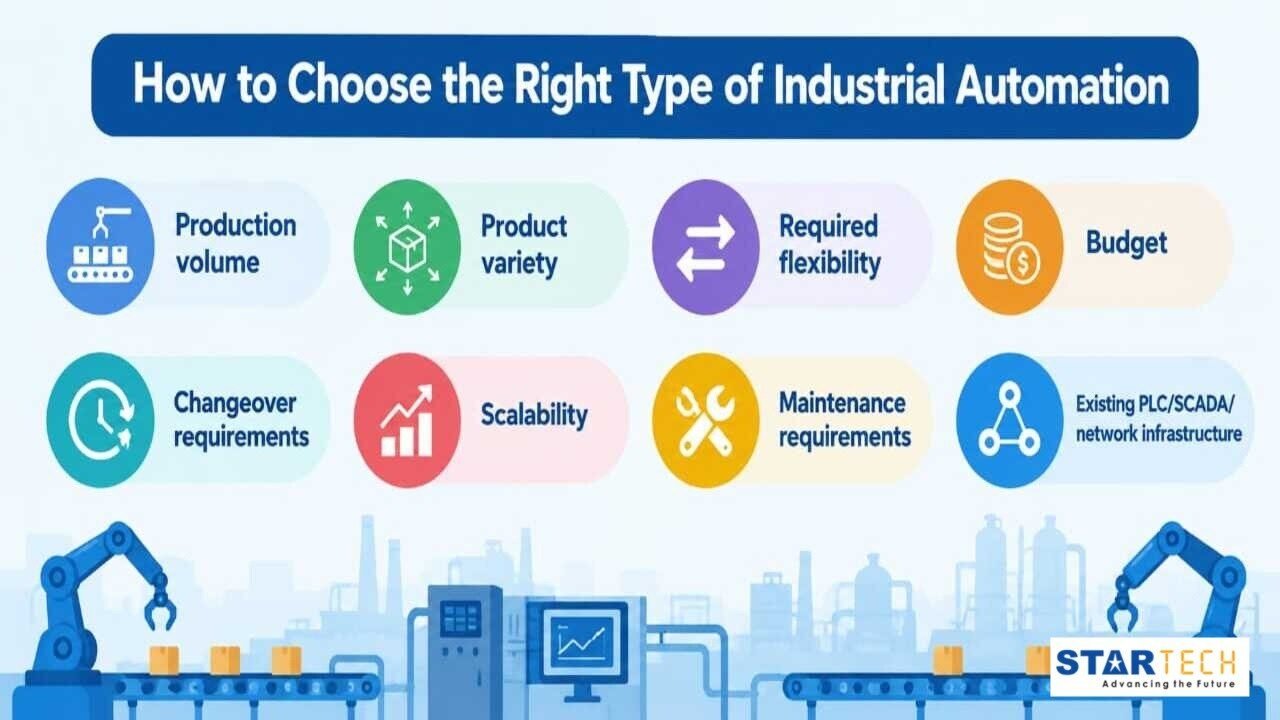
The best option isn’t automatically the fanciest one. It’s whichever one actually fits your operation. Before deciding, work through:
- Production volume — how much you actually need to produce
- Product variety — how many different products share the same line
- Required flexibility — how often products or specs shift
- Budget — upfront spend versus cost over time
- Changeover requirements — how much downtime you can tolerate between runs
- Scalability — room to grow if demand grows
- Maintenance requirements — the skill and support it takes to keep it running
- Existing PLC/SCADA/network infrastructure — what’s already there, and what a new system has to connect to
Weigh all that together and the answer usually shows itself fast. High volume, little product change, and you rarely need that extra complexity. Frequent product changes on top of solid existing infrastructure, and fixed automation tends to get outgrown quickly.