The Ultimate Ethernet Cable Guide: Choosing the Right Cable for a Reliable Industrial Network
Nobody notices the ethernet cable running through their facility — until it fails. And in an industrial setting, that failure rarely announces itself politely. It shows up as a PLC that drops packets right when a shift changes, a camera feed that stutters every time a motor drive kicks on, or a cable someone ran outdoors last year that’s now cracked down the middle after one brutal summer. Each of these traces back to the same mistake: picking a cable based on price or whatever was sitting on the shelf, instead of the environment
it actually has to survive. Downtime on a factory floor isn’t measured in minutes of annoyance, it’s measured in production hours and, sometimes, safety risk. So this guide walks through the three ethernet cable types industrial teams ask about most often — plain Cat6, the shielded “Cat6e” variant, and outdoor-rated Cat6 — and gets specific about where each one belongs.
What Is an Ethernet Cable and Why Getting It Right Matters
At its core, an ethernet cable is just copper wiring in a jacket — four twisted pairs, arranged with a precise number of twists per inch, moving data between switches, PLCs, cameras, sensors, and workstations. The twisting isn’t decorative. It’s what cancels out electromagnetic interference and crosstalk between adjacent pairs. The category number stamped on the jacket (Cat5e, Cat6, Cat6a, and so on) tells you the bandwidth ceiling, the data rate it’s certified to carry, and the distance it can carry that data reliably, per standards set by the Telecommunications Industry Association (TIA) and ANSI.
In an office, a cable that underperforms its rating might just mean a slower download. On a plant floor, the same shortfall can mean a safety interlock that doesn’t report back fast enough, a vision system dropping frames mid-inspection, or a SCADA link that quietly degrades until it fails during a critical run. Industrial environments throw variables at cabling that office buildings never have to deal with — vibration, EMI from VFDs and motors, wide temperature swings, moisture, physical abrasion from foot traffic or machinery. That’s really why cable selection has to be driven by the environment first and the spec sheet second. The next three sections dig into the options most industrial buyers are actually choosing between.
Cat6 Ethernet Cable — The Reliable Choice for Everyday Industrial Networks
For most industrial networks, a standard Cat6 ethernet cable is simply the default — and it earns that spot. Rated to 250 MHz, it carries Gigabit Ethernet (1000BASE-T) at the full 100-meter distance and can even push 10 Gigabit speeds (10GBASE-T) at shorter runs, up to roughly 55 meters. That covers the vast majority of cabinet-to-cabinet or office-to-floor connections without breaking a sweat. Compared to Cat5e, the tighter twist ratio and better insulation in a Cat6 ethernet cable also cut down on crosstalk noticeably, which matters once you’ve got several runs bundled together in a tray or conduit.
For the everyday stuff — managed switches, HMIs, workstations, non-critical sensors, anything living in a climate-controlled panel room or an office area next to the floor — a Cat6 ethernet cable is going to be your most cost-effective, dependable choice. It’s stocked everywhere, easy for a technician to terminate on-site, and plays nicely with basically every networking device on the market. Where it starts to struggle is proximity to serious EMI sources — large motors, VFDs, welding gear — and anywhere exposed to moisture, UV, or temperature extremes, which is exactly where the next two options come in.
Cat6e Ethernet Cable — The Powerful Upgrade for Demanding Environments
Quick honesty check before going further: “Cat6e” isn’t a real TIA or ISO/IEC standard. The officially recognized categories stop at Cat6 and Cat6a (augmented Cat6). What you’ll find in the market is that distributors and manufacturers use “Cat6e ethernet cable” as shorthand for an enhanced, usually shielded (S/FTP or F/UTP), version of Cat6 — built to push performance closer to, or sometimes right up against, Cat6a in noisy environments. It’s worth flagging this plainly, because knowing exactly what’s on the spec sheet — rather than trusting a marketing name — is part of doing this job properly on a critical network.
Functionally, though, a Cat6e ethernet cable does something genuinely useful: the foil or braided shield around the pairs meaningfully cuts down the interference that leaks in near VFDs, servo drives, induction heaters, and high-voltage switchgear. That makes a shielded Cat6e ethernet cable a solid pick for machine rooms, motor control centers, or any run that has to cross power cabling at some point. The catch is cost and installation complexity — shielded cable only delivers on that promise if it’s grounded correctly at both ends, and an ungrounded shield can actually make interference worse, not better. So when you’re specifying a Cat6e ethernet cable, get the shielding type confirmed, loop in your electrical team on grounding, and check the datasheet against Cat6a anyway if bandwidth is also a priority
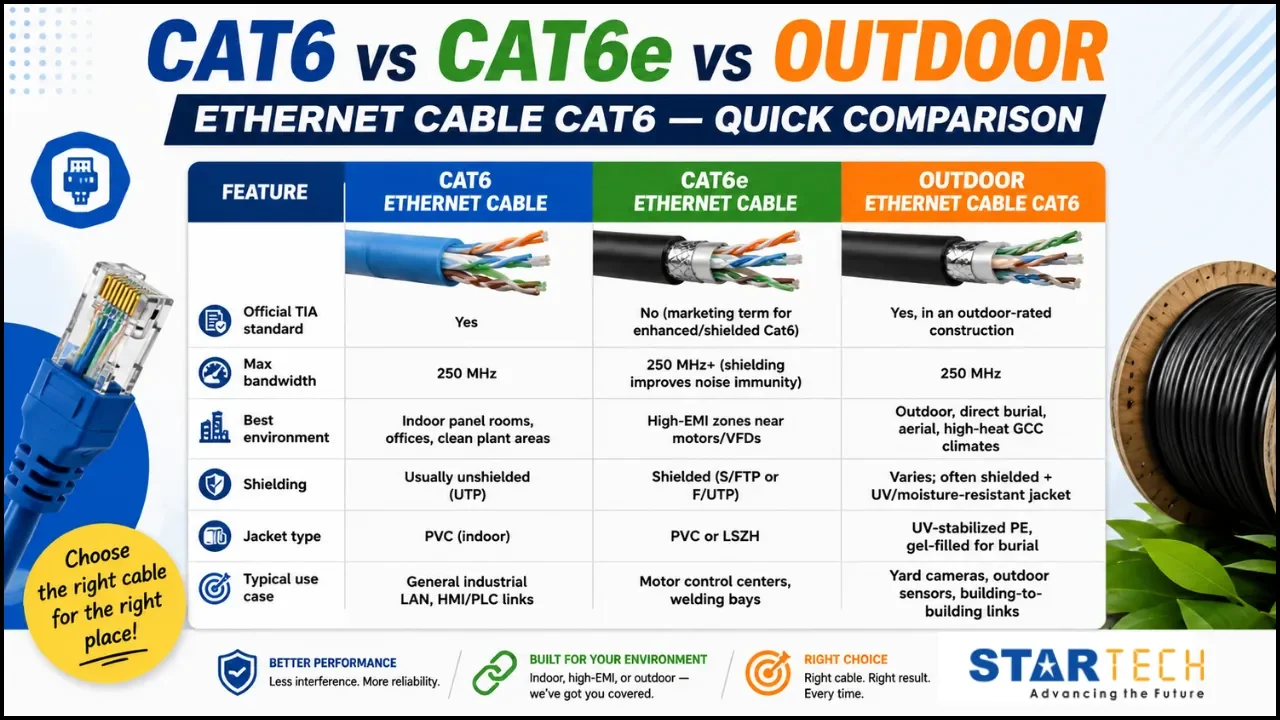
Cat6 vs Cat6e vs Outdoor Ethernet Cable Cat6 — Quick Comparison Table
How to Choose the Right Ethernet Cable and Avoid Costly Network Mistakes
If you’re a procurement manager or system integrator specifying cable at any real scale, it really comes down to a short checklist rather than one universal “best” pick Getting this right up front is a lot cheaper than re-pulling cable through conduit or re-terminating a failed outdoor run six months later — the labor cost of doing it twice almost always dwarfs the price gap between the right cable and the cheap one.

- Check the certification, not the label. If a vendor hands you “Cat6e” with no shielding spec sheet attached, that’s worth pushing back on before you order in bulk.
- Match the cable to your PoE load. Power over Ethernet generates heat inside a bundled run, and higher PoE classes (PoE++) need better conductors — sometimes shielded, sometimes larger gauge — to avoid insertion loss once that heat builds up.
- Design for the environment you actually have, not the average one. Even two meters of a run passing near a VFD can justify shielding the whole length, since EMI doesn’t care that the rest of the path was fine.
- Plan around climate before distance. In GCC deployments especially, outdoor jacketing and UV/heat tolerance should be checked before bandwidth specs — a cable that looks great on paper but softens after six months of desert sun was never really fit for the job.
- Keep termination consistent across the run. Mixed T568A/T568B termination, damaged connectors, or bend-radius violations during install will drag down performance even on a perfectly specified cable.
Conclusion
An industrial network is really only as strong as its weakest cable run, and each option here solves a different piece of that puzzle. Standard Cat6 ethernet cable is still the right call for everyday indoor connections where cost and simplicity matter most. Cat6e ethernet cable earns its keep near motors, drives, and other noisy equipment — as long as it’s properly shielded and actually grounded.
And outdoor ethernet cable Cat6 isn’t optional for anything facing sun, moisture, or ground contact, especially in a GCC climate where an indoor-rated jacket just won’t hold up. What ties all three together is discipline in specifying: know exactly what standard you’re buying against, match it to the environment the cable will actually live in, and check the datasheet rather than the marketing name on the box. Get that part right up front, and the payoff is a network that just runs quietly in the background instead of generating a support ticket every quarter.
FAQ
1. What's the real difference between Cat6 and Cat6e ethernet cable?
Cat6 is a recognized TIA standard; “Cat6e” isn’t. In practice, Cat6e ethernet cable just means a shielded, enhanced version of Cat6 aimed at better noise immunity in high-EMI industrial settings, while plain Cat6 is usually unshielded and fine for general-purpose runs.
2. Can I use a standard Cat6 ethernet cable outdoors?
Not really, no. Standard Cat6 uses indoor-rated PVC that degrades fast under UV and moisture. For any exterior, buried, or aerial run, go with an outdoor ethernet cable Cat6 built with UV-stabilized jacketing instead.
3. Does an outdoor ethernet cable Cat6 give up any speed compared to indoor Cat6?
No — it meets the same 250 MHz / Gigabit spec as indoor Cat6. The difference is entirely in the jacket and environmental protection, not the throughput.
4. If my cable management is already good, do I still need Cat6e ethernet cable?
Sometimes, yes. Tidy cable management helps with crosstalk but does nothing for EMI bleeding in from a nearby motor or VFD. If a run passes within a meter or two of high-power equipment, shielded Cat6e ethernet cable is still the safer bet.
5. What PoE class can a standard Cat6 ethernet cable handle?
Standard Cat6 handles PoE and PoE+ comfortably at typical industrial run lengths. Once you’re pushing PoE++ (Type 3/4) through a dense bundle, shielded cable or a lower bundle density is worth considering to manage the extra heat.